Since we talked about shoulders last week, it makes sense to talk about the neck this week.
Shoulder angle has a big effect on the neck. If you look at the skeleton of a horse with a laid back scapula:
...and a horse with a staighter scapula:
You can see that the angle of the shoulder affects the neck position quite a bit.
The neck is a lever. The head and the neck should make up 1/3 of the horse's body length in an ideally conformed horse. Too short and things like jumping are harder, too long and his balance and ability to collect are affected.
Some common neck traits:
Ewe neck: over developed under neck, under developed topline, dip in front of the withers (can be corrected with training and topline development)
Swan neck: literally the opposite of ewe neck, with an overdeveloped upper neck and underdeveloped under neck, so the horse can get behind the vertical, lean on the bit and curl his nose to his chest. Both ewe- and swan-necked horses often have a dip in front of the withers as well due to the way their necks are muscled.
Ha, couldn't resist! He really does have a swan neck.
These next two describe the point at which the neck is attached to the rest of the body:
Low neck tie-in (also sometimes called a nesty neck, and sometimes, but not always, related to a straight shoulder):
The neck appears to start at the bottom of the chest.
High neck tie-in (again, sometimes, but not always, related to a laid-back shoulder):
The neck appears to come out of the top of the chest.
Fun fact: excessively long, thin necks have been associated with Wobbler Syndrome, possibly due to the compression put on the spinal cord at the end of the neck.
Let's talk about my favorite thing: shoulders. I'm a sucker for a nice shoulder. Everyone one trait that catches her eye and sometimes blinds her to other bad conformation traits. For me, it's totally shoulders. Shoulders and neck tie-in are the first thing I look at - when I see a good one, I have to consciously take a deep breath and ask myself "Okay, sure that's a nice shoulder, but where does this fellow fail otherwise?"
Totilas. Nice shoulder. My version of barn-blindness.
So, what are we looking at when we're looking at shoulders? Three things.
1. The degree of the angle formed by the scapula and the humerus (Discussed in terms of having an "open" or "closed" shoulder)
2. The length of the humerus
3. The slope of the shoulder when measured against the horizon (Discussed in terms of having a "vertical" or "laid back" shoulder.)
A straight and upright shoulder causes the horse to take more and shorter strides due to the shorter muscles attachments it has. This increases concussion/risk of lameness, and can be pretty jarring to ride. Upright shoulders are usually associated with a short, steep humerus bone, so it's that much harder for the horse to fold his front legs and get his shoulders up over a jump, although it does mean the horse is able to accelerate quickly. There are degrees of straight/laid-back, so I would cull depending on the degree of straightness. I've tried to put photos in this post of extremes, so that you can see and identify it more easily.
Straight shoulder. Scroll back and forth between Totilas's photo at the top and this guy to get a good handle on seeing this trait.
A laid-back shoulder is where it's at if you're a performance person. It's the opposite of a straight shoulder: longer muscle attachments mean longer strides, the shoulders are mobile enough to swing freely to minimize concussion, less concussion means a reduction in your horse's chances of things like DJD and arthritis occurring early. These horses make for a more comfortable ride for a couple of reasons: first, it's a less jarring ride, and second on a horse with a straight shoulder, the spot where the rider sits on the horse's back is close to the front legs. A sloping shoulder pushes the rider's seat back in an anatomically advantageous position.
Related fun fact: horses with laid-back shoulders are often the ones that need anatomic girths, because the saddle sits further back than it does on a horse with a straight shoulder, often behind the girth groove.
I don't have a conformation photo of this fellow, but I know he doesn't have a straight shoulder and short arm bone based on how high he's got his front end over this fence - the scapula is totally rotated back here.
Totilas's laid-back shoulder in action:
Scapula totally rotated back
One more laid-back shoulder, though this was taken at an annoying angle for a conformation post. I think they are deliberately trying to make his shoulder look bigger in this photo, so keep that in mind:
So I'm working ahead, drafting some posts for Tracy's 5 Day Challenge, and I got to: 11. Critique your horse's conformation.
And I knew this needed to be a whole post by itself. And I realized I was ready to continue the Sunday conformation series, because I got all hot and bothered talking about Connor's conformation. So without further ado, I'm skipping ahead a bit:
Oh boy! I might not make it past this question. (ETA: I didn't.)
Connor almost passed his breeder's ultra-critical conformation eye to become a stallion, but in the end, was gelded. His full brother Cadence did make the cut (That was punny, I'm sorry). I'm grateful, since Connor wouldn't be mine if he were a stallion.
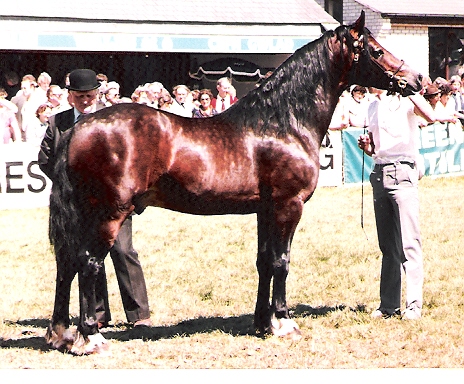
A young Derwen Desert Express, a highly influential sire in Lisa's ponies, including Connor. You can see a lot of similarities between him and all of her ponies, (including the feathers!)
There's so much to like on Connor, as there are on all of Lisa's ponies. Nicely sized head (with a somewhat small eye), high-set neck of an appropriate length, wiiiiiiide open shoulder angle (between the scapula and the humerus), a long humerus and also a nice degree of shoulder slope (the degree the scapula lays back, as judged against the 180 degree horizon).
Like many Cobs, his back is just a hair long - not something that would matter if he were pulling carts like his breed is meant to do. Despite the long back, his "coupling" (the place where the spine suddenly feels squishy in the loin area) is not too far back, which is a really good thing for a horse doing Dressage and jumping - it's powerful instead of weak.
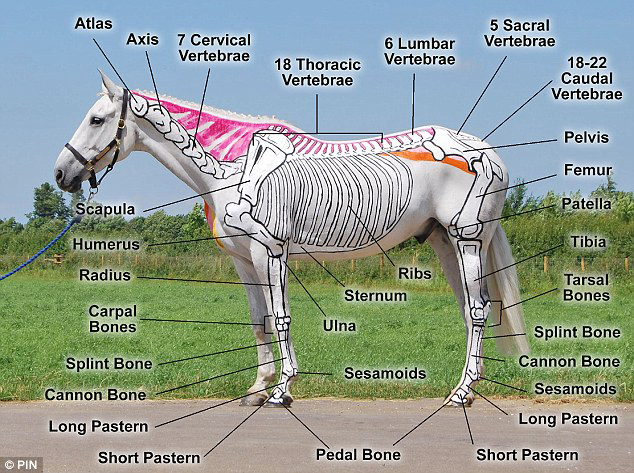
Right below the numbers 24 and 25, at the very top of the back where the red muscle appears to be "pointing" into the white area, that is the coupling. Try and feel it on your horse next time you go to the barn - the bony spine suddenly turns squishy in that area.
Connor's hindquarters are a bit steep from the point of the hip down, a nod to being a pulling breed (check out a Clydesdale or a Shire if you want to see a real goose rump!). His hind legs have a nice angle and are appropriately set on his body - if you were to draw a line from the point of his rump to his hock to the ground in the photo above, it would be straight. His hindquarter is built to propel him forward in that big Welsh Cob trot.
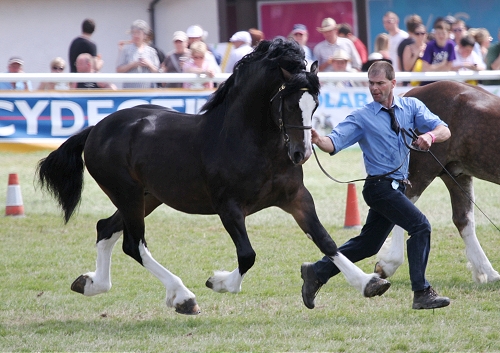
UK stallion Gwynfaes Noah demonstrating that big Welsh Cob trot, summer 2013 (Also, I would like to point out that I feel the same way about this horse that teen girls do about Justin Bieber, i.e., if I ever met him, I think I'd squeal with glee and be unable to talk coherently. He's pretty freakin awesome.)
I just realized I missed the front legs. From the side, Connor's front legs are close to ideal. Not behind or over at the knee, cannon bones much shorter than the radius bone, 45 degree pastern angle, generous and well-shaped feet. It's when you stand in front of him that you can fault the front legs: his right leg is turned out at the knee and his cannon bones are slightly offset.
Lead rope is sort of in the way but also helps you to see that the right leg turns out from the knee. (February 2013)
When you see an offset leg (and they're terribly common, I don't know if I've ever seen a textbook straight leg) you need to find out where it starts. Is the whole leg offset from the body down, or just from the knee down, or just from the pastern down? All those little bones of the knee, which look like a few rows of cubes stacked next to each other on top of a big column (the cannon bone) need to articulate just so, and any deviation puts stress on parts of the leg that shouldn't have that kind of stress.
Connor's whole leg turns out starting with the right knee, and he wings out with the left fore. The right leg situation is actually better than just the knee itself being turned out with the rest of the leg being straight - in Connor's case, those little bones are articulating correctly with the cannon bone, but not with the radius above them. I wouldn't cull for it, in his case, but I am glad I'm aware of it and paying attention to it just in case it needs maintenance down the line since he is in a show home.
So there you have it, I've ripped my poor pony to shreds. It's a good exercise for any horse owner, in my opinion, so that you know where your possible problem areas lie and can plan for the maintenance necessary to keep him living a happy and productive life. None of them are perfect! I threw a lot of stuff at you without explaining it very well, any questions for this week?
I know, you are all excited to delve into conformation photos and angle analyses. Me too! But before we do that, we need a frame of reference for understanding how we got where we are today, conformationally, and why that's important.
Back in the days of horse-powered transportation and farming, soundness really mattered. Functional conformation is sound conformation when a horse is working for a living, and just like you wouldn't buy a car model that you knew was prone to engine failures, you wouldn't breed a to stallion that was prone to soundness problems when you were breeding your next car/tractor equivalent. I'm not saying there weren't unsound animals back then, but unsound animals were selected against on principle.
Now that horses are luxury animals bred for sport and play and appealing to judges, things are different. For example, take the Quarter Horse, a breed that has undergone dramatic changes in the last fifty or sixty years. (Disclaimer: I like Quarter Horses. I'm using them because they're a very visible example of what I'm trying to illustrate, and because we discussed this particular phenomenon extensively in college.)
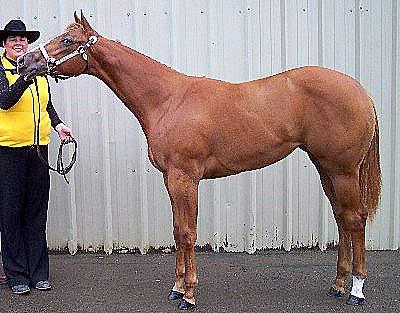
Here's Royal King, an influential Quarter Horse sire born in 1943:
Royal King
Check out this sweet video from 1943 of Royal King cutting a cow (sorry for the Italian slides in there - Italy LOVES American Quarter Horses - but the footage is very cool.):
Royal King was 14.3hh, compact, solid, good bone, and was slightly downhill with a nice hind end, allowing him to stay low, sit and chase a cow.
Fast forward a few decades. Taller Quarter Horses become very fashionable as different sports like Western Pleasure gain in popularity. People start selecting for taller Quarter Horses. But how do you add height to a historically short breed?
You breed the angles out of them. If you were only looking at height - single-trait focused breeding - you breed for height and ignore everything else, so when a horse comes out slightly taller than his parents because his hind legs are straighter, it's a success. Then because a single stallion can influence a whole breed so heavily, that one trait can spread like wildfire if the judges decide they like it, and become magnified in the breed over time.
The horse above wouldn't stay sound enough to do daily ranch work and wasn't bred for that! His breeder didn't intend for it - this is an important point. But he might be just what a Western Pleasure rider or halter handler is looking for.
Pick any breed and you can see evidence of single-trait focused breeding based on show-ring influences - not in every breeder's herd, of course, but generally speaking. Thoroughbreds: speed at the age of 3, hang the soundness/foot quality. Welsh Cobs: big trot, hang the back conformation. Arabians: super dished face, hang the ability to breathe. Paint horses: color, hang the everything else. Breeding for color can get you in a lot of trouble if you're not careful.
As you look at horses with the intention of learning more about conformation, keep those questions in the back of your mind: Why was this horse bred? What was he bred to do? What traits were desirable to his breeder? What show-ring forces might have influenced the breeding decision? Sometimes the answers to those questions are simple, and sometimes they are very complex, but they all have an effect on why a horse is formed the way he is - you can't look at the individual without also looking at the big picture.
L. Williams suggested in my 'Nature vs Nurture' post that this blog should do a few conformation posts, and that sounded like a lot of fun to me! Developing an eye for conformation makes our favorite activity, staring at horses, into a fun new game of 'I Spy' - who doesn't like that?
Conformation is important because:
1. It will decide whether or not your horse stays sound in the sport you have chosen for him.
2. It will dictate whether or not he can easily physically succeed at the sport you have chosen for him.
Every horse has conformation flaws, without exception. Recognizing your horse's conformation flaws is important because you need to understand what's going to feel like simple addition and subtraction to your 'student', and what's going to feel like calculus - "I'm never going to get this!"
When you're horse shopping with a goal of buying a competitive athlete, or just idly playing Canter Cutie Bingo, I believe you should start with a "conformation hit list". This list is going to look different for every sport- in cutting, being built downhill is advantageous, while in Dressage, it makes life very difficult.
Here are the three categories in my conformation hit list:
Jen's Conformation Hit List Group 1: Wish List (The Green Category)
Remember when you daydreamed about the traits your ideal husband/wife/partner would have, knowing that maybe you wouldn't end up with someone who had all of those traits? This is that list. Dream big! This list should contain conformation traits that would provide an advantage to a horse competing in your sport and anything you really want to see in your future equine partner - knowing your future horse won't have every single one.
This fellow has several green-list qualities of mine, including a nice open, sloping shoulder, hocks nicely balanced and angulated, short cannon bones, good pastern angles, and good angulation in his hind quarters.
Group 2: Things You Can Live With (The Yellow Category)
You might not define this group as explicitly as you do the other two. This category is comprised of both traits that are neither advantageous nor disadvantageous, and also traits that maybe aren't ideal, but you feel that you can comfortably manage them.
Slightly over at the knee - it would never be on my green list, but if he was otherwise awesome I wouldn't cull for it (in a jumper), so it goes in my "yellow" category. Behind at the knee, on the other hand, is on my red list for a jumper.
Group 3: Things You Would Cull For (The Red Category)
This should be an explicitly defined group. What would make you pass over a horse? What will set a horse up for failure in your chosen sport? That's this list, and it will be different for everyone. For example, a couple of things on my 'cull' list are things that increase concussion: small feet and upright pasterns. Also on my list are things I just don't want to deal with, like poor quality feet. But on someone else's list, poor quality feet might be in the "Yellow" list because they feel they can manage it, or the horse is otherwise worth it, and that's totally fine!
Small feet and upright pasterns - this is a cull for me as an eventer, but not in Western halter where concussion isn't a factor.
After I've culled for the 'Red List' traits I can't live with, I can then weigh non-conformation factors like brain, temperament, bravery, etc against the Green and Yellow categories. It's really important to first cull 'red traits' before culling for brain traits.
Say you're choosing between one horse with 2 green traits and 5 yellow traits that is smart, patient, and brave, and a second horse that has 5 green traits and 2 yellow traits but he's crazy. In this case, you might choose against the better conformed horse to pick the better brain, and since you've already culled everything in your 'Red' category, you know you'll be conformationally okay no matter what you decide. This saves you a lot of heartache and possible injuries down the road.
I would really like to encourage open discussion on these conformation posts, so feel free to ask questions or call me out or engage in discussions. I love chatting about conformation!








.jpeg)


