Horses are fragile
 |
I know this comparison is going to make me sad, and I'm doing it anyway.
|
 |
November 2020. Someday she's going to look like this again!
|
You think you know this, and then you're suddenly slapped in the face with it like this and suddenly the reality of that statement sets in. One of the vets said horses' bodies are poorly suited to fighting off infection compared to other animals, which I've never thought about before, but it makes sense. There are probably fewer opportunities for a long convalescence as a prey animal than there are as a top-of-the-food-chain human, so humans have gotten the chance to evolve infection-fighting immune systems more completely. "They're just big, fragile, poorly designed animals in a lot of ways," the one vet said.
There's still much we don't know about equine medicine.
 |
Me, age 5-ish, with Sammy, my family's first African Grey
|
After having African Greys for almost 30 years, I'm used to working within the constraints of incomplete veterinary understanding of my pets, following guidelines that are more "old wives tale" and "err on the side of caution" than published study because I don't have anything better to rely on. But I always thought horses were closer to dogs and cats on the animal science spectrum until this. I've never been told "I don't know" as many times with a horse as I was during this ordeal, and that's not a knock on the vets in any way, I appreciate the humility it takes to say that, but they really just did not know in many cases from start to finish with this. Even the amount of time she was on a feeding tube (2 weeks) was uncharted territory!
There are things much worse - emotionally and financially - than (successful) colic surgery.
 |
| Far, far less gory than it was a few weeks ago! |
Obviously if your colic surgery ended tragically, there's nothing worse than that. But I spent my whole life thinking colic surgery was a worst case veterinary medicine scenario. Planning for it financially, holding it up in casual conversation as a big tragedy. But I found myself many times WISHING this was something as simple as colic surgery, something where, within a matter of minutes, you have a concrete diagnosis of a well-understood ailment, an action plan, a firm cost estimate, and you can take a big step to fix it almost immediately.
Contrast that to what we went through: we don't know what caused this, we don't know how long it will take for her to leave the hospital, we don't really know how to fix it, we don't know how much this will cost. We'd authorize the bill through a certain amount, and they'd call a week later to get another authorization to continue, having used that amount up. We faced a situation where every day was a gamble, every dollar we spent was a bet placed that her nerves would come back to life before we got to the point we couldn't afford to keep her up there and alive anymore. The uncertainty was gut-wrenching in a way that I never thought was possible.
Pre-existing vet relationships are important.
 |
Happy to be back at Lisa's, who is better set up for small pen turnout than I am
|
I am so grateful we had my new vet out for spring shots way earlier than we usually did this year, so he had just seen her two days before all this started. I used to do my own shots, back when that's what I could afford, but now I will cheerfully fork over the farm call fee to have my vet see my healthy animal once a year, just so I have someone to call in an emergency like this. And it has transformed my relationship with this vet for the better - nothing like trial by fire!
The list of people I would co-own a horse with is now up to two.
 |
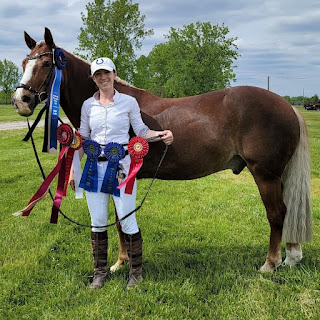
Lisa with Connor's stallion full brother, Cadence
|
I used to say Mary was the only person on the planet I could co-own a horse with, but after this experience I can confidently add Lisa to that list. We worked as a team throughout this entire thing, often making decisions together, but sometimes we both had to make decisions independently too. It meant a lot that she had that much trust in me, and that 11 years into our friendship, I know her well enough to read her mind and confidently authorize treatments even when I couldn't reach her to double check. Sometimes the way we arrived at a decision took different paths, but we always arrived at the same place regardless, and that was pretty cool.
There are differences between private practice hospitals and university hospitals, and now I know them.
Anyone who's read this blog knows Purdue had a big miss on this case, but they also saved her life. The downsides to a teaching hospital are the rotating cast of characters, (if your horse is there longer than one rotation) and the relative inexperience of the non-senior vets. The upside is that it's cheaper - I am not saying this was cheap by any means, but it was a heck of a lot cheaper at Purdue than Rood and Riddle would've been, and then the longer we were there, the harder they worked to find "teaching funds" for things like bloodwork to make our bill even a little smaller. Honestly, if she had been at R&R, our money might have run out before her ability to swallow came back, so being at Purdue may have saved her life in that respect.
COVID-19 sucks.
 |
Back home again at Lisa's
|
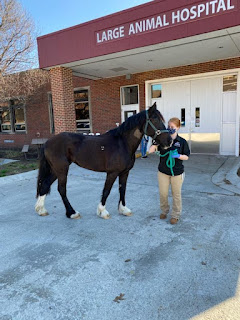
COVID-19 complicated every bit of this ordeal, from the hours I spent waiting in the truck, to peeing in my trailer, to not being able to see with our own eyes whether she was eating or not when they discharged her the first time. More than once when we both wanted to question the vets on whether something was or was not happening, I reminded Lisa that we did not have a choice but to trust them, because we weren't allowed to go see her. This virus can go to hell, and I can't wait to flip it the bird (and honor my healthy 49 year old CrossFit friend that died of it after contracting it while traveling for Thanksgiving) by signing up for my vaccination first thing Wednesday morning.
I am still not insuring Connor after all this.
I know, a lot of you probably think I'm crazy, and that's fine, insurance is 100% the right route for a lot of people. But if anything, this experience just validated my choice to self-insure (pay the amount I would be paying in premiums into a savings account every month), and I was grateful for the freedom we had to make decisions purely on what the vets said and how much we could afford, and not what insurance would/would not cover. I cannot deny that that is privilege, but it's also 11 years of planning ahead, prioritizing saving before spending every time I get paid, and being grateful that it was there when I offered to help defray some cost.
This wraps up the Aeres medical saga. Sorry for all the cliffhangers, but that's what my life felt like right alongside all you guys! I'll continue to post updates on her as I get them, but for now, her life is all about eating, gaining weight, and being a horse again.




.jpeg)


