Showing posts with label veterinary. Show all posts

February 27, 2025

Disco's Double Medical Mystery February

It's been A Month around here. Specifically, it's been February, the worst month of the year. February has no redeeming qualities for me. Every year I tell myself that this will be the February I just say f*** it and take a long weekend to somewhere warm just to remind myself there are places in the world that are green, warm, bright, and not filled with seasonal depression. And so far that has never happened. But one day!

In the meantime, we've almost made it.

But not before one last surprise snowfall that took over a week to melt, because of course it did.

Disco jumped right on the "February sucks" train by needing to see not one, but two, equine veterinary medicine professionals with mystery ailments last week.


During a cold snap when I was feeding extra night hay last week, I found Disco shivering at a cold temp, but one he normally handles well without a blanket. He was also trying to roll, but in a weird "throw my body against the wall, slide down it and just lay there" kind of way. 

I thought maybe colic and gave him banamine and electrolytes, in addition to putting the heaviest blanket I have on him. Within 30 minutes, he was acting totally normal, bright eyed and eating. So I went to bed.


The next morning, though, he was back to again displaying a sad pain face, looking miserable, and trying to roll (but still passing manure just fine). This time I also temped him, and found a 105.6F temperature! I gave him more banamine and called the vet. By the time the vet arrived a couple hours later, the banamine had only brought it down to 104F. 

(By the way, he politely chose to get sick on President's Day, which I had off from work. So that was nice of him.)

The vet wasn't sure what was going on, but gave him a banamine shot, a shot of antibiotics, and tubed him "just to be safe even though I don't think it's colic." By 6 hours later, his fever was down to 101, and that was the last of it. He was totally normal from there on out. 

After the vet visit, Disco slept most of the afternoon and Connor just stood watch next to him all day. It was adorable.
 

A few days later, Disco saw my dentist. He had just been done in Canada 7 months earlier, but anytime I start riding one that's new to me, I want to KNOW that they're physically okay with what I'm asking of them. Plus at not quite four, he's at an age where teeth change often. And it was a good thing I did.

Her winter teeth doing outfit totally looks like scuba gear.

Poor baby Disco had a line of ulcers down the left side of his cheek. To me, it looked like someone had taken a green/blue pen and drawn a line and some squiggles all the way down the inside of his cheek. While they weren't actively bleeding, they certainly still looked painful.

Disco is a much less sloppy drunk than Connor, but this particular pose must run in the family.
 

Now, my dentist is a DVM that just does teeth and bodywork. She used to be full-service, but went the specialty route, I'm sure trying to maintain a better quality of life for herself (no emergencies). She's spent the last five years studying to get, and finally last month got, her International Association of Equine Dentistry certification, which is quite challenging to get from what I understand. 

All that is to say - she is very, very good when it comes to dentistry, and she was stumped as to what caused these. He didn't have them at his last dental in Canada, and while he had a few points here and there, there was nothing that would have obviously caused that much trauma.

This is only part of the documentation you receive every time you get a dental from her.

She asked about his hay, but sort of half-heartedly, because if it was the hay, she would have expected to see trauma on the other cheek also, or on any of the other horses she did at our farm that day, and she didn't. So in the end, we got the teeth to where we know they're good and not causing any problems, and scheduled another dental in six months.


Since then, he has clearly been feeling better. He's demonstrating just a tiny bit of attitude on the ground that he didn't have before, and under saddle he was much more willing to move forward and to give on the left side. I feel bad that I didn't do this sooner, but I'm grateful that I've ridden him as lightly as I have this winter while that was going on inside his mouth.

AND WITH THAT, can we PLEASE knock it off with the vet bills for a little while, Disco!


November 15, 2021

Baby's First Vet Visit

On Friday morning, Disco saw my vet for the first time. I was crossing my fingers that he would be well-behaved, because he hadn't been turned out since Wednesday evening due to the weather, making this the longest amount of time he'd ever spent in a stall (a few minutes of turnout in the indoor the night before notwithstanding).

He was perfect. Like, I was holding him and I didn't even realize the vet had given the shot because Disco didn't react in the slightest, not even so much as an ear flick.

"This is a good baby," the vet said, "Must've been handled a lot and handled well."

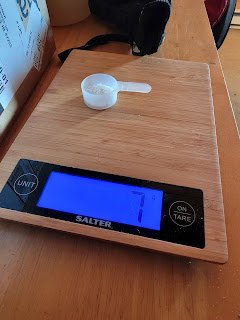
Drug scale or salt measuring operation? You decide.

Disco's mom was vaccinated during pregnancy, so up until this point he's been protected by the antibodies he received from her, but 6 months is around the time that protection begins to wane. So he got his first dose last week and he'll get a booster dose 6 weeks from now, around Christmas.

I also wanted the vet to look at his left front fetlock, which has been puffy and hard since earlier this summer. I was not opposed to x-rays or even a referral if the vet thought it was necessary, but he immediately diagnosed it as physitis, or joint inflammation caused by enlargement of the growth plate. From KER:

Considered a scourge among horse breeders everywhere, physitis is bound to pop up in any horse-breeding population sooner or later, regardless of how conscientious a breeder might be. Loosely defined, physitis is an inflammation of cartilaginous growth plates near the ends of long bones in growing horses.

Treatment for physitis is largely diet changes. My vet asked what he was fed before, and what his concentrate diet would be going forward (a FeedXL-designed diet of 1/2lb of low-starch high-fat Kalm Ultra and 1/2lb of Essential K ration balancer twice a day). 

"Oh, that's perfect, yeah, this should go away within a few months of being on that diet. If it doesn't, we can look at [some medication or supplement I'd never heard of and can't remember], but I don't think we'll need to, this is a pretty minor case. Some young horses, their joints look like boxes it's so bad."

You can see it quite clearly here, the left fore is visibly thicker above the fetlock. I'm glad this is nothing serious. PC: Leah

He also felt his man bits ("Two nuts, tiny, but they're both there, no cryptorchidism here") and agreed with my assessment to wait as long as I can to geld him. "At least the spring, longer if you can."

Finally, he discussed deworming protocols with me, and said he likes to see them wormed every six weeks until they're a year old. That sounded like overkill to me at first, but nope, a bunch of reputable sources agree with him. Young horses are most susceptible to worm infestations and serious side effects caused by worms, so even with all the concerns about resistance and as much as we've backed off on frequent deworming of older horses, the deworming protocol for youngstock is much more aggressive. So I'm still going to do fecals, but he'll be getting wormed a few more times before his first birthday in April. 

Surprise fall rain storm that actually also contained some graupel, which my husband refuses to believe is a real weather phenmenon, but it's true

I think I'm a pretty well-read and educated horse owner, but there's a lot to learn about raising a baby the first time!

March 10, 2021

The Infection: Part 7

At 1:30am on Saturday, I woke up and rolled over to look at my phone where I saw Lisa had texted that she was driving home and to call her if I was still awake. Of course I called her, how could I sleep? She ran through what the vets did that evening and let me know about the additional symptoms that had developed, but nobody really knew what was going on yet. 

Still with colic surgery in the back of my mind, I said, "We probably need to at least start having the conversation about how much is too much to put her through," and Lisa agreed, but said that she was grateful to have seen her in person that day, and that her eyes still said she wasn't done fighting this.

Hollering at her friendos when she got home

At 7:55am on Saturday, the overnight resident called me with an update. They had run bloodwork and discovered she was extremely deficient in a particular electrolyte which could have been responsible for the irregular heartbeat and the mild lack of coordination. After putting her on fluids and that electrolyte, she was "much better" and her irregular heartbeat was becoming more and more infrequent.

They thought her stomach pain was likely caused by bad ulcers (hello, take a horse with a history of ulcers, get very little food into her for 3 weeks and treat her with antibiotics - it's like a recipe for bad ulcers). Starting Saturday they told me they were going to scope her for ulcers, but in the meantime they started her on GG and Sulcrafate anyway. By Tuesday, they still hasn't scoped her, and also she hadn't produced poop in four days, so I finally put my foot down and told the resident at Tuesday morning's call I wanted her scoped, even if they didn't think they needed to.

Happy 4th(ish) birthday, Hanko!

This ended up being the best call I've made so far, because not only did they find "severe ulcers in both the glandular and the non-glandular regions of the stomach", but they also intentionally scoped her un-fasted to see how much food was getting into her stomach (normally you fast horses prior to being scoped) and it was...totally empty. 

This is the first time I've been upset with Purdue throughout this whole thing. Obviously I cannot go see and observe her eat myself due to COVID, I can't get any further than the parking lot, so I have to trust the vets when they tell me she's "ingesting 75-80% of what we give her", as was the update on Monday the 8th. Clearly that was not the case, whether it's because she's masticating it and the food is only making it as far as her mouth (we know that's partially the case, they have to syringe her mouth out to clear the food particles once a day) or it's because it's falling out of her mouth. Either way, the food is not making it to her stomach and probably hasn't been for a while. AND they discharged a patient that was not capable of EATING on Friday! What was I supposed to do with that at home?!

First porchin' of the year with a fresh Screwdriver. Had to find a way to use up all the oranges we mostly only use for peels for garnishes!

While I was upset that the horse has basically been starving for three weeks, I was also relieved, because her other majorly worrying symptom (it's Tuesday as I write this and she hasn't pooped since Friday) is likely caused by just not having enough food in her system to make any poop. That's  upsetting to me in that I hate that she was starving, but it's also a relief that we're not dealing with a colic or a perforation or twisted guts or any number of other seriously concerning problems.

So they placed a feeding tube and she's getting an alfalfa slurry fed through that three times a day. She's tolerating the naso-gastric tube well, and the irregular heartbeat cropped back up again after ~36 hours off of fluids, so she's back on fluids and electrolytes as well. 

Hopefully it's uphill from here, although someone still has to answer the question of why she's unable to swallow.We know as of Monday the 22nd when they tested her swallowing reflex everything past the tongue was normal. So is something now wrong with the esophagus? Or is this just a result of the nerves in her tongue taking their sweet time coming back to life after a pretty traumatic event? Nobody knows yet.

And now you're caught up. At the time I started writing this, it seemed like she would come home and I would settle into multiple weeks of boring wound care with very little of interest to write about, but of course with Friday night's complications, that turned out not to be the case. So I'm going to have to throw in some non-Aeres posts too, but rest assured, I'll continue updating this series as I have new updates!

March 9, 2021

The Infection: Part 6

Warning: at the end of this post there are gory surgical site pictures with pus, blood and the insides of Aeres' head visible. I'll give you an opt-out point in the post if you don't want to see that.

On Friday March 5th, I drove up to Purdue in my husband's Kia Stinger, because I was still (am still!!!!) without a truck, and met Lisa there to pick Aeres up and bring her home. I had to be there to learn how to care for her wound, and Lisa offered to chauffeur her home for me.

Aeres probably thinks she lives here now

I was given extremely strict discharge instructions. Once a day, I was to thoroughly clean the open wound so that it healed from the inside out and not the outside in. I was to take a gloved hand and run it around the inside of the wound ("don't be surprised when your fingers disappear into it, it's pretty deep") and to take two syringes of saline and shoot it all up in there. Then I was to dry her chin off and apply Vaseline so the pus and saline didn't irritate her skin. I was also to give her an IM shot of Exceed every four days starting on Monday the 7th.

Okay, I got this, finally putting that Equine Studies degree to good use.

Driving home was uneventful, and she was alert and happy with a bright expression as her feet hit the driveway, practically dragging Lisa into what she knew was her stall.

I took some pictures for Alice, on request. First of her condition, which she has lost so much of, although it will definitely come back once she is capable of eating enough to sustain herself. She looks like a two year old right now though.


Next I took some wound pics, which are at the bottom of this post with a buffer before and after so you can skip them and still comment without seeing them. 

(One rather ironic sidenote to all this: Alice is an oral surgeon, so she has an above average interest in (and stomach for) gory post-surgery photos, haha.)

Aeres settled in well and got right to awkwardly eating her chopped hay the same way she was pre-surgery. They said this was expected, and she was slowly getting better at eating and drinking, but she wasn't 100% normal yet. We did her first wound flush and Vaseline, and then went back to my house for tacos, feeling guardedly celebratory.


When I brought Lisa back to her rig at the barn a couple hours later so she could go home, we checked on Aeres. Lisa was first into the barn, and my heart dropped when she said "She's laying down."Not that she's not allowed to lay down, but any unusual symptom is gut wrenching after all that we've been through.

But then she tried to roll. And then she looked back at her flanks. Next she strained to pee. And I saw that dull look in her eyes and the slight wrinkles over her nostrils that I know as signs of pain in her by this point. And this was within a couple of hours after she had just gotten bute, so she really should've been feeling okay.

Trying to pee - this is not normal

I called Purdue's emergency line and the on-call vet listened to her symptoms and said "She needs to see a vet tonight, whether you use your vet or bring her back here." With the exception of the weird peeing, all of these symptoms were exactly the same as that Thursday night in February when this all began, so I knew although it looked like colic, it might not be, and if it wasn't colic (and maybe even if it was) she needed to be back in a veterinary hospital. Barn aisle-level care would be wasting precious time.

So four hours after she got home, Aeres got hustled back on Lisa's trailer for another two hour ride back to Purdue, where they arrived at 10pm Eastern on Friday night. She presented with a fever of 102, a mild lack of coordination, an irregular heartbeat, a blood clot at the original IV site, and "swishy" gut sounds.

...to be continued (but the gory surgical site pictures are below)

*

*

*

*

*

*

*

*

*

*

*

*

*

*

*

*

*

*

*

*

*

*


*

*

*

*

*

*

*

*

*

*

*

*

*

*

*

*

*

*

*

*

*

*

*

*


March 8, 2021

The Infection: Part 5

You're now entering the stretch of the story with very few photos, since I'm not allowed to accompany her into any of the veterinary hospitals (thanks, COVID), so you're going to get some unrelated Meatloaf pictures.

On Tuesday morning (February 23rd) at 8:55am, I got a call from the vet. Aeres had finally spiked a real fever (of 103) for the first time throughout this whole thing. After going over the risks of putting a horse under with me for what felt like the millionth time (coming out of anesthesia is extremely dangerous for horses and they make SURE you're crystal clear on that before they start anything) she hung up to go put her under.

A while later, she called and said the CT scan didn't show a foreign body, which was what we all had been hoping for. That would have been the simplest answer. But it did show a massive abscess under her tongue, which they wanted my permission to drain while she was still under. 

Meatloaf has developed a strong preference for the bucket sets in my husband's Kia Stinger GT while my truck is STILL in the shop!!

Of course I gave it, and when she called with another update a couple of hours later, she told me Aeres had come out of it fine, and had "briefly thought about going up" while coming out of anesthesia before reconsidering her poor life choices and putting all four feet back on the ground, where they stayed the rest of the time.

While she was under, they made a sizable incision between the branches of the mandible to drain an 8-10" long abscess that ran most of the length of her face and also involved the tongue. They sent off a sample for a culture to see what kind of bacteria was contained in the abscess, which almost a week later came back unfortunately negative - whatever antibiotic my vet gave Saturday night had killed the bacteria off before they cultured it on Tuesday. The negative culture didn't change much, besides the fact that we had to continue to treat her with a broad spectrum antibiotic rather than a targeted one. 

I couldn't take her to the barn for over a week, and when I finally got her out there she ran so hard, she slept from 6pm to 8am the next morning.

Her recovery was pretty straightforward until 48 hours post surgery, when I got a call that they had had to cut 2-3" of her tongue off that day due to necrosis. The pressure of the infection, which they think started in the tongue and spread outward from there, had caused the tissue of the tongue to start dying from the tip in. 

This came completely out of the blue for me, and I had tons of questions for the vet, who very conveniently had owned and competed a 3'6 eq horse that had almost his entire tongue removed so she was able to talk me through both Aeres' medical prognosis (good) and her riding horse prognosis (also good). 


Apparently horses don't need their tongues for much, and you can remove almost all of it without hugely impacting their life. ("But if she was a cow, we'd have a real problem" - vet) At the amount they took off, it might make it easier for her to get her tongue over the bit (which she thankfully has never done before so there's no pre-existing habit to worry about. If this was Connor though...lol. He'd be living that hackamore life forever), but that's it, the vet said her prognosis for a full return to work as a Dressage horse or eventer was great.

After the first tongue amputation, they had to take another centimeter off on Saturday (the 10th day after this all started and her 6th day at Purdue if anyone is counting), but that was the last of it, and she had no further complications. Six days later, on Friday March 5th, we got to take her home...temporarily.

...to be continued

March 5, 2021

The Infection: Part 4

Overnight Sunday, it rained a ton, which melted a lot of the snow...except on the barn's winding uphill gravel driveway, which, after two weeks of trucks going up and down it, had coalesced into 2" thick ice.

Despite being completely mentally frazzled by this point, I somehow had the presence of mind to think "I'm going to want a picture of this driveway for the blog" #dedicatedhorseblogger

I had borrowed my former trainer's 2500 to get Aeres to Centaur, and it barely made it up the icy driveway, so I knew going down would be a challenge. It was going to get well above freezing that day and would be thoroughly melted by Tuesday, but Aeres needed to go to Centaur NOW. Waiting was not an option.

I texted my former trainer who had the brilliant idea to take some of the mag we had stacked in the indoor for use on the footing and salt the driveway with it.

How convenient, a literal wall of ice melt

It was while I was spreading salt on the driveway that I finally cried for the first time throughout this whole thing. I fell hard on my ass, unable to keep my footing on the icy hill, and the tears came - not because I was hurt, but because it was so damn frustrating that after keeping this sick horse alive for four straight days and spending every moment of every day worrying about her, I was 45 minutes away from handing her off to the best vets in the state, if only I could get her down the driveway!

In the end, the mag melted enough of the ice to where we could get down, and also my former trainer came out to drive the rig down the driveway for me. Truth be told, I was so mentally spazzed at this point I could barely think straight, but also, it was her truck, and I'd rather her be the one to bury it into the fenceline than me, if it came to that.

Ended up being a great, if unwanted, opportunity to see how a 3/4 ton handled the World's Tiniest Horse Trailer. Verdict: much better than my 2005 half ton, but surprisingly not as well as my 2018 half ton. HD truck suspensions are intended for much heavier loads than the World's Tiniest Horse Trailer, while the WTHT is squarely in the middle of what my half ton is capable of towing. Not that it did poorly, it just wasn't quite as planted at interstate speeds.
 

During the 45 minute drive to Centaur, I called my mom, who was, at the same moment, driving to University of Illinois' veterinary hospital to put her African Grey down due to cancer at an extremely young age for a Grey. I was supposed to be there for that, but I had my own shitty college vet appointment to go to. Like mother, like daughter, at the worst possible moment, but always there for our pets til the end <3

After four hours of waiting in the truck and peeing in my horse trailer because I couldn't go inside (real talk) (thanks COVID), the vet finally came out to talk to me. Everything about her was normal past the tongue - swallowing reflex was normal if they shot water into the back of her mouth, no fever, gut motility was great.

So Centaur's best guess was that there was a foreign body in her tongue, and although the vet put on a confident air with me, my vet told me later that when the two vets talked, the Centaur vet was just as stumped as he was. She needed either a CT scan ($1,500) or an MRI ($3,000) to see what was going on in there, my choice. I chose CT scan in consultation with Lisa after they told me both would provide the type of data they needed equally well.

I was accepted into this prestigious program at work and should have been in California this week for the annual conference, but of course it was virtual this year. They asked us to share selfies on Day 1 and I was like "Ok, you asked for it, bringing my whole self to work!" At least I specialize in work from home software, so this whole post (and our anywhere/anytime/any device slogan) is just one big advertisement for my products.


And that's when they informed me their CT scanner at Centaur was in the process of being replaced, and I would have to haul her to either Purdue or Rood and Riddle. Purdue was just under two hours from there and R&R was just over two hours, so I chose Purdue, not wanting to prolong what had to have been a miserable trailer ride for Aeres any longer than I had to.


I know it's a gas 2500. It says HEMI on the side. But I still texted her before filling it up to double check because putting gas in a diesel truck would have been par for the f****** course this week.

After another two hours of waiting in the truck while they got fluids into her and did paperwork, and then a two hour drive, I got her to Purdue main campus at 5:06pm on Monday afternoon, where they gave her supportive care overnight (still no fever!) and planned to put her under for the CT first thing in the morning. It was the first time in five days I felt my anxiety subside, knowing I was no longer solely responsible for getting her through this.

...to be continued

March 4, 2021

The Infection: Part 3

On Saturday evening, I again hitched a ride to the barn from a barnmate. It was quickly obvious Aeres had relapsed - more foaming at the mouth and picking at her feed, but this time her entire muzzle was swollen, and there were large swellings under her jaw right above her chin. So the swellings were not where I'd expect to see them if this was strangles, which would affect the lymph nodes closer to the throatlatch.

Saturday morning, muzzle wasn't really swollen yet

She had been perfectly fine that morning, so I surmised that one of two things had happened: either this was caused by a plant she wouldn't normally eat that she was eating in turnout due to the snow, or the steroid from the night before had made her temporarily feel that much better, and when that wore off, she relapsed. 

The vet warned me it would be 90 minutes before he got out there because he was already at an emergency, so I used my nervous energy to walk her snowy field looking for signs that she'd eaten a plant at the edge of the field out of boredom or something. Nothing. 

Took pictures of all of the plants she has access to over the fence just in case

I'm not proud of the amount of horsey WebMD'ing I did during this particular wait for the vet. The vet honestly and apologetically admitted he was stumped at this point, and so was I. So many things lined up symptomatically except for a single symptom: colic, trauma, strangles, vesicular stomatitis, botulism, even rabies. 

This of course had me nervous that it was something transmissible, despite the fact that none of the other horses had symptoms, everyone eats the same diet, and no one had shipped in or out in nearly two months, since Connor came home. The vet was confident it wasn't infectious, but also didn't know what it was so his confidence wasn't exactly comforting.

Checking for the coronary band lesions that would indicate VS and finding none

(Mildly Related Public Service Announcement: During my incessant Googling I learned that early symptoms of rabies in horses looks a whole lot like colic, and if you come into contact with that horse's saliva while treating it for "colic", you have to get the extremely painful series of rabies vaccines or you die. So if your horse is not vaccinated for rabies, at least have that in the back of your mind any time your horse is sick.)

When the vet arrived, he noted that she still had no fever, and her salivary glands (near the chin) were the fullest he'd ever seen on a horse. He'd seen swollen salivary glands twice in his career, but both were on seniors, and like me, was perplexed that there was no lymph node involvement.

He wondered if maybe a calcification had blocked her salivary ducts, so we took a series of X-Rays, which showed nothing.

Getting increasingly tucked up on Saturday morning, but still passing the tent test

He tried to insert a catheter into the salivary glands, but they were too swollen for even that. He spent multiple hours out there with me, apologizing profusely for being so stumped by this. In the end, he hit her with another round of steroids and for the first time, some antibiotics (literally put a needle in her neck and emptied syringe after syringe into her) and left me with two syringes of Dex to give orally the next day. 

At 9:30pm I finally went home, in a vehicle borrowed from yet another barnmate so that no one had to wait that whole time with me (except Meatloaf - best wingman). Barn family really came in clutch for me through all this.


The next morning (Sunday the 21st) she was again foaming at the mouth and just generally blah, so he had me give her Dex and that immediately perked her up. She ate an entire tub of chopped hay which was great because she hadn't had a full meal in over 72 hours at that point and I was very concerned about both starvation and colic. Her poops were small and infrequent due to how little she was eating, but she was peeing normally, probably in part due to the steroids.


It was Sunday evening that I noticed something weird about her drinking. During this whole thing up to this point, she had been drinking a lot. I watched her do it, and watched the muscles of her throat "swallow" each time. But on Sunday I noticed she was backwashing into her auto-waterer via her mouth (which unfortunately is not one of the models that has a counter on it), so I gave her a bucket and observed her drink out of that now that it was finally above freezing.

Horrified, I realized after 30 seconds of "drinking", the bucket had barely gone down at all, and I realized she had been trying and trying to drink without getting hardly anything into her body at least since Saturday morning - getting just enough to keep her alive and from colicking for real, apparently.

Frustrated "drinking"

It was at this point that the vet said he was referring her to Centaur (Purdue University's state of the art satellite equine clinic located 2 miles from my old barn) first thing the next morning, Monday. Monday would also be the first time in weeks I had even a prayer of getting the truck and trailer safely down our very steep snow covered driveway.

...to be continued

March 3, 2021

The Infection: Part 2

At the time I got that text message at 6:30pm on Thursday night, I was on Day 2 without a truck, snowed in at home with our only other vehicle (my husband's RWD sports car) unable to get me out of the garage, let alone up the steep and winding barn driveway. I texted a barnmate and asked if he could pick me up and take me out there, on a night that saw a low of 4F.

Barn driveway after Snow #1, we got another 8" on top of this a few days later that was still hanging around when all this Aeres stuff happened

When I got out there, I honestly couldn't tell if she was choking or colicing. She had good gut sounds, but kept looking back at her flanks and laying down. She coughed up that brown paste once or twice, but didn't have any discharge coming out of her nose. I gave her banamine just in case we were dealing with a choke that had led to a colic and called the vet. Not my horse - I wasn't messing around.

The vet (my new vet, an older gentleman with decades of experience) was perplexed. He found only a very slight fever that he mused could have been the result of getting stressed over the choke. He found good looking poop during the rectal exam. He tubed her and confirmed there was no current choke bolus and no stomach reflux. He did mineral oil in case of colic, and water to get some hydration into her system.

(I also have to add that she had gotten her shots from this vet two days before, his first time meeting her, but we quickly ruled out vaccine side effects that only started two days later and weren't accompanied by any injection site swelling).

Not happy

By the time he left around 9:30pm Thursday night, she was resting quietly and looking for hay, although none of us were convinced it was either a colic or a choke. For both ailments, all of the symptoms lined up except one, which was so frustrating. He gave me some specific feeding instructions and told me to text him in the morning.

The texts I sent him in the morning were not encouraging - picking at her breakfast and general malaise, but with two new symptoms: foaming at the mouth and quidding her hay. I had a different barnmate pick me up at home and run me out there (where we both did the Work From Home thing in the barn's office and tack room respectively), and from there I texted the vet with updates throughout the morning. He decided he needed to come out again and arrived around 2pm. This time, he sedated her and looked in her mouth, where we found these:

Two identical big yellow swellings on either side of her tongue, in the same spot. It was such a damn relief to find A Thing we could point to as The Problem rather than this nebulous collection of symptoms that didn't quite line up with any known illness.

The vet thought they looked like the result of trauma, and rounded the nearby teeth off just to take pressure off of them while they healed (although her teeth didn't cause this, I had her done in September when she first got here and they still looked good). She had had no fever since the very slight possibly false positive the night before, so we weren't thinking infection. He gave her a steroid injection, but no antibiotics.

Only the beginning of Aeres' no good very bad week

We were all so elated by this finding and the vet's confidence that this was it, plus the fact that she felt good enough to eat relatively normally the rest of the afternoon. It really felt on Friday afternoon like we were on the right track, which was a relief especially to me. Ever since I got that choke text on Thursday evening, I had had this constant feeling of existential dread. Not my horse, not knowing what was wrong, not being free to go to the barn anytime I wanted to and feeling so helpless - helpless to help her, helpless to get myself to the barn - was gut wrenching. If I wasn't at the barn, I was sitting at home wondering if I was going to walk into a dying horse the next time I found a way to the barn, and that went on all weekend.

But on Friday afternoon, we thought we were on the right track. Even Saturday morning, when she ate chopped hay normally and went straight out and took a long drink at the trough, we thought we had it licked.

Connor shyly telling his lady friend he missed her

Then Saturday night rolled around...

...to be continued

March 2, 2021

The Infection: Part 1

Alright, I finally have the green light to share my shitty February with you all. Buckle up, because this saga has more twists and turns than a checkout line romance novel.

The whole time I had her, Aeres was not really for sale. She was going to go home and be a momma unless the PERFECT situation came up, and wouldn't you know, one did. A current Castleberry Cob owner contacted Lisa looking for basically Aeres, in a nutshell, and is the absolute perfect show home for her.

She flew in to try her February 5th (fully vaccinated, so jealous, I miss flying so much!), and they clicked from the very beginning. Not one to hide anything, I let the prospective buyer groom her, tack her up and turn her out when we were done too, wanting her to get the full Aeres experience. Aeres just absolutely loved her.

All cleaned up by the dream team the night before

The buyer (or long-term leaser, I don't know and don't care what the mechanics of the sale end up being, Lisa will do whatever ends up being right for the horse), who I will call Alice for the sake of the blog, reminded me so much of myself in that she's a great rider but a little nervous on a strange horse, and she told us before she got on she definitely didn't want to jump her.

(Hello I feel that, I was afraid to jump FLOUNDER last time I rode at Kate's barn, and I'm the Flounder Fan Club President).

Best school pony

But it says a lot about how much they clicked that, by the time she finished flatting, Alice trusted Aeres enough to ask if she could pop her over a crossrail. In anticipation of this, Mary and I had left the barrel line up from her last jump school two days before, just to give still-green-over-fences Aeres the best chance of success if the buyer asked to pop her over something, and that all worked exactly as we envisioned it. They were perfect for each other.

This exercise (Mary aboard here). We took the barrels out for the trial.

Watching them go around, it felt SO GOOD, I had this big stupid grin on my face the entire time. To see this horse that came in with ulcers and ear shyness and head tossing and a Jesus-take-the-wheel canter transition and a complete lack of understanding of snaffle contact go around like she could get her first and second level Bronze scores tomorrow with a new-to-her amateur rider felt AMAZING. She found her person and her calling, and it felt good to be a part of that story.

The next couple of weeks were a blur of text messages - getting the shipper arranged, figuring out if we could fit a semi up the driveway, and coordinating shots/coggins/health certificate (with a new vet, because my awesome sporthorse vet up and quit and moved to Florida this winter - can't say I blame her but what a loss for the area). Finally it was all set that Aeres would leave on Monday February 22nd.

And then. 

The Thursday before she was to get on the bus to go to Alice, I got a text and a picture from the night barn crew.

"I think Aeres is choking. She laid down in her stall after dinner and she got right back up but I was worried she had some gas so I walked her for 20-30 minutes. She let me take a look in her mouth and I'm seeing some food paste in the back."

What came out of Aeres' mouth

...to be continued

February 25, 2020

Back Pain Recheck Appointment and Saddle Search Update

My vet came out yesterday and did a three week re-check on Connor's back.  Last time, I watched as his back sank and flinched away from her fingers.  This time, I told her I was 100% confident she would tell me he's better, but I wanted to hear it from her anyway just because.

I am so happy to report his recheck couldn't have gone better.  She couldn't get him to react to the palpation in the slightest - not even an ear flick!  She was amazed and delighted, and said we had done a fantastic job rehabbing him, that his topline was already changing, and just the way he stood in general looked totally different and more relaxed.  She did a tiny little mini adjustment, and his body was soft like putty when she was done.

And has a new Micklem!  Thanks, Carly.
Over those three weeks, I rode only in my CWD and he also got lunged a few times.  I used the band system for every ride/lunge, and also put Connor through a series of stretches recommended by my vet and CGP before most rides.  So I guess the moral of this story is that you really do need to keep riding when you have a back sore horse - as long as you've removed the cause of the soreness.

And that brings me to the flapless.  ESS had one more thing we could try, but with as close to show season as we are, unless they were 100% sure it would work, I wasn't willing to gamble on another round of back soreness.  I said if Carmi ever comes to this part of the country on one of her fitting tours, I'd be willing to have her fit him in person, but for now, I'm sending the trial back and not moving forward with it.


(If anyone in this part of the country would like to try the flapless at a fitting tour, let me know in the comments - critical mass is important to getting her out this way).

It's a bummer.  I still love that saddle, and I think it's a great saddle for a lot of people/horses, but like any saddle, both horse AND rider have to love it, and Connor let me know he didn't like it.  And that's okay.  We made it through this back soreness episode, and I'm DELIGHTED at the work he's been giving me lately, so no permanent harm done.

Look at those symmetry scores!

This may surprise you all, but the Patrick is also out for me.  I did like it, and we had a good year at work so I can afford it, but it literally costs more than I paid for my had-never-had-a-horse-in-it-before trailer, and I just can't square my brain with dropping that much money on something as temporary as a saddle (all saddles are temporary, as JenJ reminds me regularly).

So I'm going to continue riding in the CWD, and in the meantime, there's a plan C in the works, and a plan D on deck, just in case I need it...

As always (will this ever end?) to be continued...