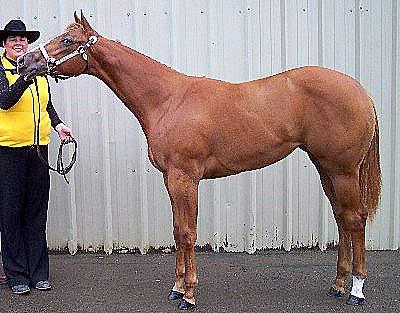
Connor's six-year-old full brother, Castleberry's Cadence, is a stallion standing at Kendalwood Farm in PA, where Connor spent a while as a 4 year old. Connor's breeder is expecting Cadence's first foal crop in 2015, and I CANNOT wait to see them!
Conformationally, he takes much more after their sire than Connor does, Connor favors their dam, but Cadence got their dam's liver chestnut coat.
He has a better shoulder and neck than Connor, and a better length of back, but you can still definitely tell they are related!
It was cold but beautiful for my Sunday ride, and they had just repainted the doors of the little barn yesterday, and the sun was perfect, so I tried to take some pictures and they all turned out bad. C'est la vie!
Google automatically made this one pretty for some reason.
Blindingly white doors.
Tried for a conformation shot.
How not to take a conformation shot...meet my Western pleasure horse.
We had a good Dressage ride, though, and then when I got home (just in time for Colts kickoff, I can't be the only person who schedules rides around the NFL and MLB, anyone else?) my husband had cleaned the whole house and had a burger ready for me when I got home. He may not come to the barn with me, but stuff like that means he's supporting my riding anyway.
After Tuesday's not-so-great ride, I was hoping Thursday's lesson would be better since it was the last one I'd have until my trainer returns from Florida in March, but he was still blah. Focused this time, but dull. We decided that Sunday's trainer ride and the wild temperature swings were to blame for his malaise, and we didn't push it too hard.
The biggest thing I got out of the lesson is that he still doesn't have enough bend on the circle - his body is straight and he's traveling sort of diagonally. We worked on spiral in/out and focused on another Dr. Deb Bennettism, which is that "if paint is dripping from his nose and his tail, there should be one line of paint on the ground where you've ridden." It helped me a lot; his nose wasn't even on the circle before I started thinking in terms of paint.
I'm responsible for Saturday and Sunday stalls for the two weekends they're gone, and I decided to give him a break from riding for a few days too. After finishing up chores today, I took advantage of our first and last 50 degree day for at least the next week by pulling his mane (I don't pull manes under 50 degrees!):
Aunt Mary is delighted, she recoiled in horror when she saw how long his mane was in the videos from a few weeks ago.
And I took some new conformation shots to go along with it - it's been a while since my last monthly conformation shot!
We also tried on bell boots - he has started clipping his front feet with his hind feet, which I am delighted about on one level - my long-backed pony wasn't even close to tracking up when I first got him, let alone hitting himself. On another level, that's not a good thing and he has small cuts there, so we need to take care of those and let them heal.
Also FEATHERS!!
Beautiful sunny day, won't you stay a little while longer?
I know, you are all excited to delve into conformation photos and angle analyses. Me too! But before we do that, we need a frame of reference for understanding how we got where we are today, conformationally, and why that's important.
Back in the days of horse-powered transportation and farming, soundness really mattered. Functional conformation is sound conformation when a horse is working for a living, and just like you wouldn't buy a car model that you knew was prone to engine failures, you wouldn't breed a to stallion that was prone to soundness problems when you were breeding your next car/tractor equivalent. I'm not saying there weren't unsound animals back then, but unsound animals were selected against on principle.
Now that horses are luxury animals bred for sport and play and appealing to judges, things are different. For example, take the Quarter Horse, a breed that has undergone dramatic changes in the last fifty or sixty years. (Disclaimer: I like Quarter Horses. I'm using them because they're a very visible example of what I'm trying to illustrate, and because we discussed this particular phenomenon extensively in college.)
Here's Royal King, an influential Quarter Horse sire born in 1943:
Royal King
Check out this sweet video from 1943 of Royal King cutting a cow (sorry for the Italian slides in there - Italy LOVES American Quarter Horses - but the footage is very cool.):
Royal King was 14.3hh, compact, solid, good bone, and was slightly downhill with a nice hind end, allowing him to stay low, sit and chase a cow.
Fast forward a few decades. Taller Quarter Horses become very fashionable as different sports like Western Pleasure gain in popularity. People start selecting for taller Quarter Horses. But how do you add height to a historically short breed?
You breed the angles out of them. If you were only looking at height - single-trait focused breeding - you breed for height and ignore everything else, so when a horse comes out slightly taller than his parents because his hind legs are straighter, it's a success. Then because a single stallion can influence a whole breed so heavily, that one trait can spread like wildfire if the judges decide they like it, and become magnified in the breed over time.
The horse above wouldn't stay sound enough to do daily ranch work and wasn't bred for that! His breeder didn't intend for it - this is an important point. But he might be just what a Western Pleasure rider or halter handler is looking for.
Pick any breed and you can see evidence of single-trait focused breeding based on show-ring influences - not in every breeder's herd, of course, but generally speaking. Thoroughbreds: speed at the age of 3, hang the soundness/foot quality. Welsh Cobs: big trot, hang the back conformation. Arabians: super dished face, hang the ability to breathe. Paint horses: color, hang the everything else. Breeding for color can get you in a lot of trouble if you're not careful.
As you look at horses with the intention of learning more about conformation, keep those questions in the back of your mind: Why was this horse bred? What was he bred to do? What traits were desirable to his breeder? What show-ring forces might have influenced the breeding decision? Sometimes the answers to those questions are simple, and sometimes they are very complex, but they all have an effect on why a horse is formed the way he is - you can't look at the individual without also looking at the big picture.
L. Williams suggested in my 'Nature vs Nurture' post that this blog should do a few conformation posts, and that sounded like a lot of fun to me! Developing an eye for conformation makes our favorite activity, staring at horses, into a fun new game of 'I Spy' - who doesn't like that?
Conformation is important because:
1. It will decide whether or not your horse stays sound in the sport you have chosen for him.
2. It will dictate whether or not he can easily physically succeed at the sport you have chosen for him.
Every horse has conformation flaws, without exception. Recognizing your horse's conformation flaws is important because you need to understand what's going to feel like simple addition and subtraction to your 'student', and what's going to feel like calculus - "I'm never going to get this!"
When you're horse shopping with a goal of buying a competitive athlete, or just idly playing Canter Cutie Bingo, I believe you should start with a "conformation hit list". This list is going to look different for every sport- in cutting, being built downhill is advantageous, while in Dressage, it makes life very difficult.
Here are the three categories in my conformation hit list:
Jen's Conformation Hit List Group 1: Wish List (The Green Category)
Remember when you daydreamed about the traits your ideal husband/wife/partner would have, knowing that maybe you wouldn't end up with someone who had all of those traits? This is that list. Dream big! This list should contain conformation traits that would provide an advantage to a horse competing in your sport and anything you really want to see in your future equine partner - knowing your future horse won't have every single one.
This fellow has several green-list qualities of mine, including a nice open, sloping shoulder, hocks nicely balanced and angulated, short cannon bones, good pastern angles, and good angulation in his hind quarters.
Group 2: Things You Can Live With (The Yellow Category)
You might not define this group as explicitly as you do the other two. This category is comprised of both traits that are neither advantageous nor disadvantageous, and also traits that maybe aren't ideal, but you feel that you can comfortably manage them.
Slightly over at the knee - it would never be on my green list, but if he was otherwise awesome I wouldn't cull for it (in a jumper), so it goes in my "yellow" category. Behind at the knee, on the other hand, is on my red list for a jumper.
Group 3: Things You Would Cull For (The Red Category)
This should be an explicitly defined group. What would make you pass over a horse? What will set a horse up for failure in your chosen sport? That's this list, and it will be different for everyone. For example, a couple of things on my 'cull' list are things that increase concussion: small feet and upright pasterns. Also on my list are things I just don't want to deal with, like poor quality feet. But on someone else's list, poor quality feet might be in the "Yellow" list because they feel they can manage it, or the horse is otherwise worth it, and that's totally fine!
Small feet and upright pasterns - this is a cull for me as an eventer, but not in Western halter where concussion isn't a factor.
After I've culled for the 'Red List' traits I can't live with, I can then weigh non-conformation factors like brain, temperament, bravery, etc against the Green and Yellow categories. It's really important to first cull 'red traits' before culling for brain traits.
Say you're choosing between one horse with 2 green traits and 5 yellow traits that is smart, patient, and brave, and a second horse that has 5 green traits and 2 yellow traits but he's crazy. In this case, you might choose against the better conformed horse to pick the better brain, and since you've already culled everything in your 'Red' category, you know you'll be conformationally okay no matter what you decide. This saves you a lot of heartache and possible injuries down the road.
I would really like to encourage open discussion on these conformation posts, so feel free to ask questions or call me out or engage in discussions. I love chatting about conformation!
Since Mary came, I've been thinking a lot about nature vs. nurture - kind of. Specifically, I've been thinking about how conformation and training affect movement.
I studied conformation in college under the tutelage of Dr. Marks, conformation queen, and I know exactly what sort of conformation faults I can live with and what I can't. I've always loved Connor's shoulder: that nice, sloping shoulder should make it easy for him to rotate his scapula and get his knees up over fences.
...right?
Early September 2013
The truth is, I'm learning that even if a horse is conformed in a way that makes certain things easy for him, there's still a massive training component to things like becoming a careful jumper with good form and tight knees over fences. Good shoulder conformation will make the road toward good jumping form easier for him than it would be for a horse with a straighter shoulder, all other factors being equal, but it doesn't make good form happen from the first time he ever takes a fence. And just because doesn't know how to get his shoulders rotated quickly now doesn't mean he never will.
Good form happens when teaching moments like this...
...teach him what it means to snap his knees up quickly, and then combine with favorable shoulder conformation to produce this:
"Perfection on a stick" (Dr. Marks' favorite conformation line), won't take you where you want to go without the training and temperament to go with it, even if it seems like it should. It's something I've never really thought about until now.
Thoughts? This is new territory for my brain, I'd love some opinions.
Is it just me, or is Connor finally starting to look like a mature Cob? Just recently he's started to look less immature and more like an adult Cob to me, with the depth of his girth looking more equal to the length of his leg, as it should be in his breed. He is coming seven this May, so that would be about right. I like the weight he's at right now, regardless.
Horses that will win in a sport that requires functionality rather than aesthetics to win will be bred to be functional rather than spotted, or pretty, or whatever the judge is looking for that show season. I'm not just picking on the Western world here, either. A horse that was able to stay sound when he pulled a plow five days a week and a buggy on Sundays was incredibly valuable, but that's not valued as highly in a twice-a-year trail pony, or a halter horse, or a low-level eventer whose owner can afford the necessary veterinary care to maintain minor unsoundnesses. I'm not saying you have to buy conformational perfection-on-a-stick, or that it's a bad thing to maintain minor unsoundnesses, but I am saying that sports like this becoming popular can only help the state of the breeding industry (at least in quality, still haven't resolved the quantity problem...), which I have commented on before. Compared to peanut rolling, trantering western pleasure, which I got very familiar with in college, this is a huge leap forward.
Also, they appear to have cue cards instead of Dressage letters and memorized tests, which makes me giggle.




.jpeg)


